

Fiber arts covers a large spectrum of disciplines, focusing on the materials used, such as yarn or fabric. The new class at TEEN DAY Ithaca is covering five different units: embroidery, weaving, crochet, knitting, and macramé. Each has its own distinct tools, traditions, and skills, which encourages students to learn how to read patterns, improve their hand-eye coordination, and cultivate their creativity!
Charlotte Albunio, a PhD student in mechanical engineering at Cornell University, is teaching this class. She believes in recognizing the medium of fiber arts as just that, an art, not to be dismissed as a craft or women’s work, as it has been traditionally. In this class, she hopes students are learning and understanding the historical nuances of fiber arts and can express themself through their work.
“Taking Charlotte’s fiber arts class has been one of the most rewarding art classes I’ve taken.” — Aaren S.

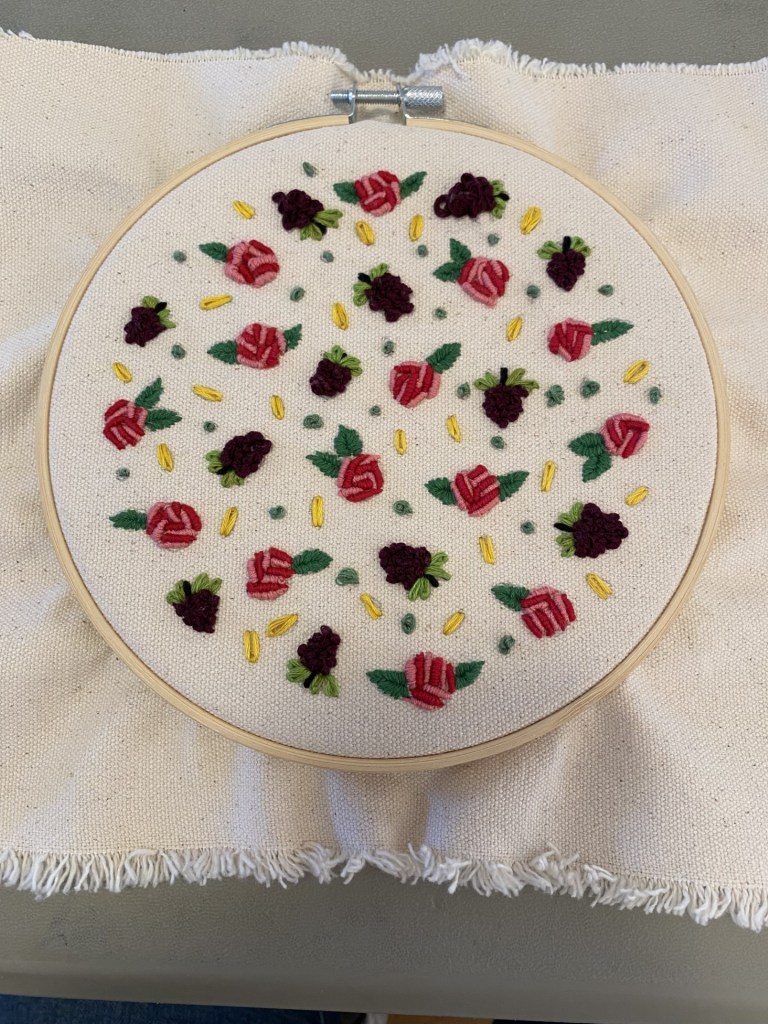
Until recently, the participants have learned how to embroider and weave. For the embroidery unit, students were instructed on the basic stitches, how they form different shapes and textures, how to read the stitches’ abbreviations (this allows them to follow along with patterns), and were allowed to choose between six different patterns to complete with the help of the instructor when needed.
This photo was sent to me by Juliet A., a student in the class. The image depicts the hoop, fabric, and various stitches used when embroidering. The hoop holds the fabric taught, which allows for better stitch definition and an easier time embroidering. Many projects can be completed with these stitches, although there are more.
“Embroidery has been my favorite so far—it makes me feel like I’m in a Jane Austen book!”— Juliet A.
In addition to the embroidery unit, students focused their efforts on weaving. They were instructed to make their own looms with cardboard and wooden dowels, materials many people already have on hand. Fiber arts can be very expensive, so it’s important to emphasize that it doesn’t always have to be. If you are interested in fiber arts, there are often cheaper alternatives.

In this unit, students were instructed on the basic stitches to prepare them for their personal projects, much like the embroidery unit. For their personal projects, participants were instructed to create a small bag. They chose their own yarn, colors, and stitch design.
The image on the left depicts the tabby and the soumak stitch. The former stitch is the most basic and consists of weaving the yarn back and forth. The latter stitch is made up of looping the weft threads over the warp threads (the weft thread is the working yarn, and the warp threads are the vertical threads). The result of this technique is the braid-like appearance.
These projects were wrapped up in the past weeks, and the students have started on their next unit: crochet. Once this unit, as well as macramé and knitting, are complete, students will enter the second half of the year and focus more on a large-scale work combining all the skills they have learned. Students are creating wearable pieces, mixed-media self-portraits, and a cumulative studio project. In this final project, students are designing their own patterns and creating a piece that represents their personal vision as a “thesis.”
“The structure is designed to empower students to use fiber arts as a mode of self-expression and identity, creating meaningful work that can be incorporated into their daily lives as something they wear, display, or gift.” — Charlotte A.
 TEEN DAY Ithaca